What Digital Transformation for Small Business Really Means in Michigan
Digital transformation for small business in Michigan isn't about flashy apps, it's about fixing workflows that waste time and money.
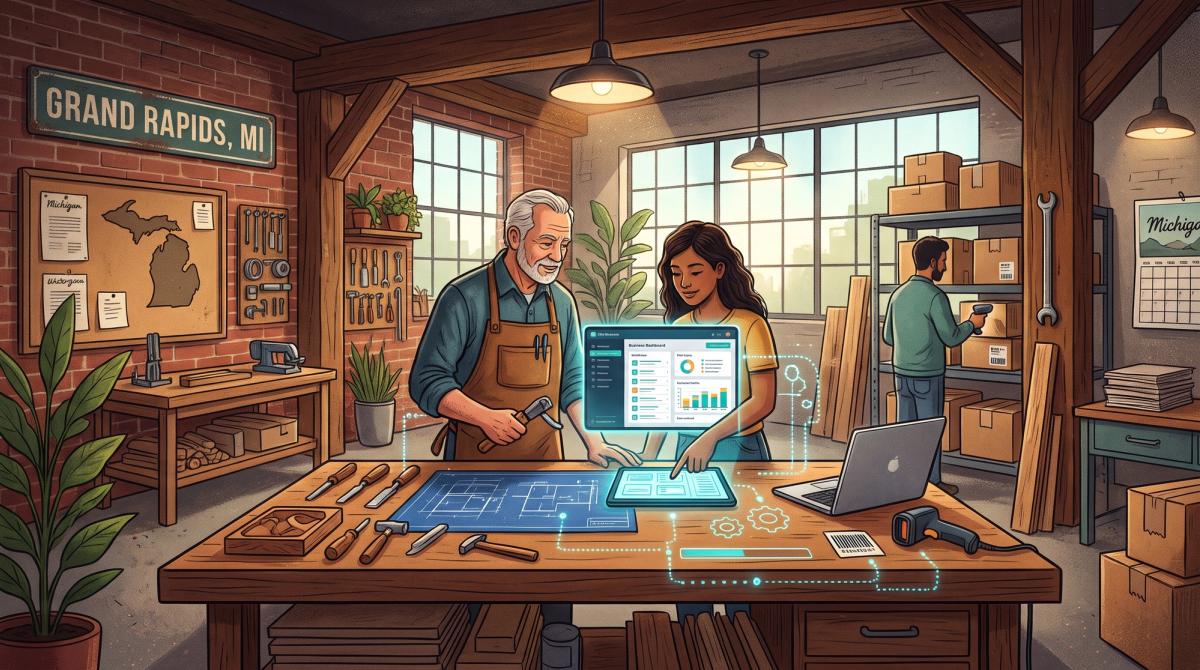
Digital transformation for small business gets said so often that the phrase has almost stopped meaning anything. For a lot of Michigan owners, it brings to mind Silicon Valley startups with big budgets and developers on call. That’s not what it looks like for a family-owned manufacturer in Grand Rapids or a regional service company in Ann Arbor.
For most small and mid-sized businesses, digital transformation is smaller and more practical than the buzzword suggests. It means replacing the spreadsheet three people edit at once with a system that doesn’t break. It means a customer request that used to take five phone calls now takes one form. It means the owner stops being the only person who knows how invoicing works.
What Digital Transformation Means for a Small Business
Digital transformation is the process of replacing manual, paper-based, or disconnected processes with connected digital systems. That could be software that automates a repetitive task, a database that replaces a filing cabinet, or an AI tool that writes the first draft of a document someone used to start from scratch.
Think of it as a series of smaller upgrades rather than one big project with a finish line. Each upgrade solves a specific bottleneck. A business that automates scheduling this year and inventory tracking next year is going through a digital transformation, even if nobody in the building ever calls it that.
Why Many Michigan Small Businesses Still Run on Older Systems
Michigan’s economy has deep roots in manufacturing, logistics, and family-run service businesses. Those industries were built on physical processes long before software showed up. Many of these companies still run on systems set up ten or twenty years ago that have been patched together ever since.
That’s not a knock on anyone. Those systems did their job for a long time. But as labor gets harder to find and margins get tighter, the cost of manual work gets harder to ignore. What used to be an inconvenience becomes the reason a business can’t take on more customers without hiring another person.
5 Signs Your Business Needs a Digital Transformation Project
- The same data gets typed into more than one system by hand
- One employee is the only person who understands how a critical process works
- Customers or vendors regularly wait on information that should be instant
- Reports take days to pull together instead of minutes
- Growth is limited by how many people you can hire, not by demand
If two or more of these sound familiar, your business is probably paying a hidden tax every month in wasted hours and missed opportunities.
How Much Does Digital Transformation Cost a Small Business?
This is where a lot of owners get scared off. Enterprise software projects can run into six or seven figures, and that price tag tends to get attached to the whole idea of digital transformation, whatever the size of the company.
A small business doesn’t need an enterprise rollout. A targeted, fixed-price project that automates one workflow, or connects two systems that don’t currently talk to each other, can be scoped, priced, and delivered without an open-ended budget. The goal is a specific fix with a specific return. Nobody needs a platform overhaul they didn’t ask for.
The businesses that get the most out of digital transformation start with one painful process, not a company-wide overhaul.
Where to Start With Digital Transformation for Your Small Business
The best place to start is whatever process visibly frustrates you or your team every week. That frustration usually means the workflow is costing real time and money. It also usually means the problem is small enough to fix without disrupting everything else.
Digital transformation for a Michigan small business doesn’t require a five-year plan or a new department. It takes picking one workflow, fixing it with the right tool, and measuring whether it actually saved time. Once that works, the next bottleneck usually becomes obvious, and you repeat the process one fix at a time.
FAQ
What does digital transformation mean for a small business?
For a small business, digital transformation means replacing manual, paper-based, or disconnected processes with digital systems that work together. That might be automating scheduling, swapping shared spreadsheets for a proper database, or using an AI tool to speed up document drafting. It’s usually a series of small upgrades, not one large project.
How much does digital transformation cost for a small business?
It depends on scope, but it doesn’t have to look like an enterprise budget. A focused project that automates one workflow or connects two systems can be scoped and priced up front, so you know the cost before work begins.
Where should a small business start with digital transformation?
Start with the process that frustrates you or your team every week. It’s usually costing real time and money, and it’s often small enough to fix without disrupting the rest of the business.
How do I know if my business needs digital transformation?
Common signs include typing the same data into more than one system, relying on one person who understands a critical process, customers or vendors waiting on information that should be instant, reports that take days to compile, and growth that’s limited by hiring rather than demand.
Do I need to replace all my existing systems at once?
No. Most small businesses do better by fixing one workflow at a time. Keep the systems that work, upgrade or connect the ones that don’t, and measure the results before moving on to the next bottleneck.
Is digital transformation only for tech companies?
No. Manufacturers, logistics companies, service businesses, and family-run shops can all benefit. In many cases, businesses built on physical processes see the biggest gains, because they have the most manual work to streamline.
AI Transparency: This article was drafted with the assistance of AI and reviewed, edited, and shaped by the author’s own opinions and experience.